Market Notes
Interest Costs Top $1 Trillion and the Fed Hiked, 2026

The Take
The Fed raised rates on September 17 and then spent 2 weeks telling the market it probably won't go again in October. That's a pause, not a pivot, and December is still live. What got less attention is the borrowing side, where net interest on the federal debt ran past $1 trillion with a month still left in the fiscal year. So the 10 year yield sitting at 5.31% isn't only a Fed story, it's a supply story, and I don't think soft growth data brings it down.
What the Data Shows
Start with what the Fed actually did and said. The FOMC raised the target range a quarter point to 3.75% to 4.00% at the September 15 to 16 meeting, and Vice Chair Philip Jefferson said on October 1 that inflation has run above the 2% target "for more than five years." New York Fed President John Williams had already set the frame on September 29, saying "there is no need for urgency" while adding that "one further upward adjustment of the federal funds target range may be appropriate late this year." Richmond's Tom Barkin titled his September 22 speech "Why Hike" and answered it in one line: "The risks to inflation outweigh the risks to maximum employment."
The data under that is split. Headline PCE inflation ran 3.4% year over year in August 2026 and core PCE ran 3.0%, both from the BEA price indexes published through August. The labor market went the other way on October 2, when BLS reported September payrolls up just 29,000, unemployment at 4.2%, and July and August revised down by a combined 60,000. That's soft jobs and sticky prices at the same time, and the Fed hiked into it.
Now the part that never shows up in a Fed statement. CBO's September 9 Monthly Budget Review put net interest at $1,052 billion for the first 11 months of fiscal 2026, up $111 billion or 12% from the same stretch a year earlier, against a deficit of $2.0 trillion. BEA's second quarter data has federal interest payments running at $1.28 trillion annualized versus $1.19 trillion for national defense, so interest is the bigger line now. Total public debt was $40.24 trillion on October 2 per Treasury's Debt to the Penny, and federal debt to GDP was 122.6% in the first quarter of 2026.
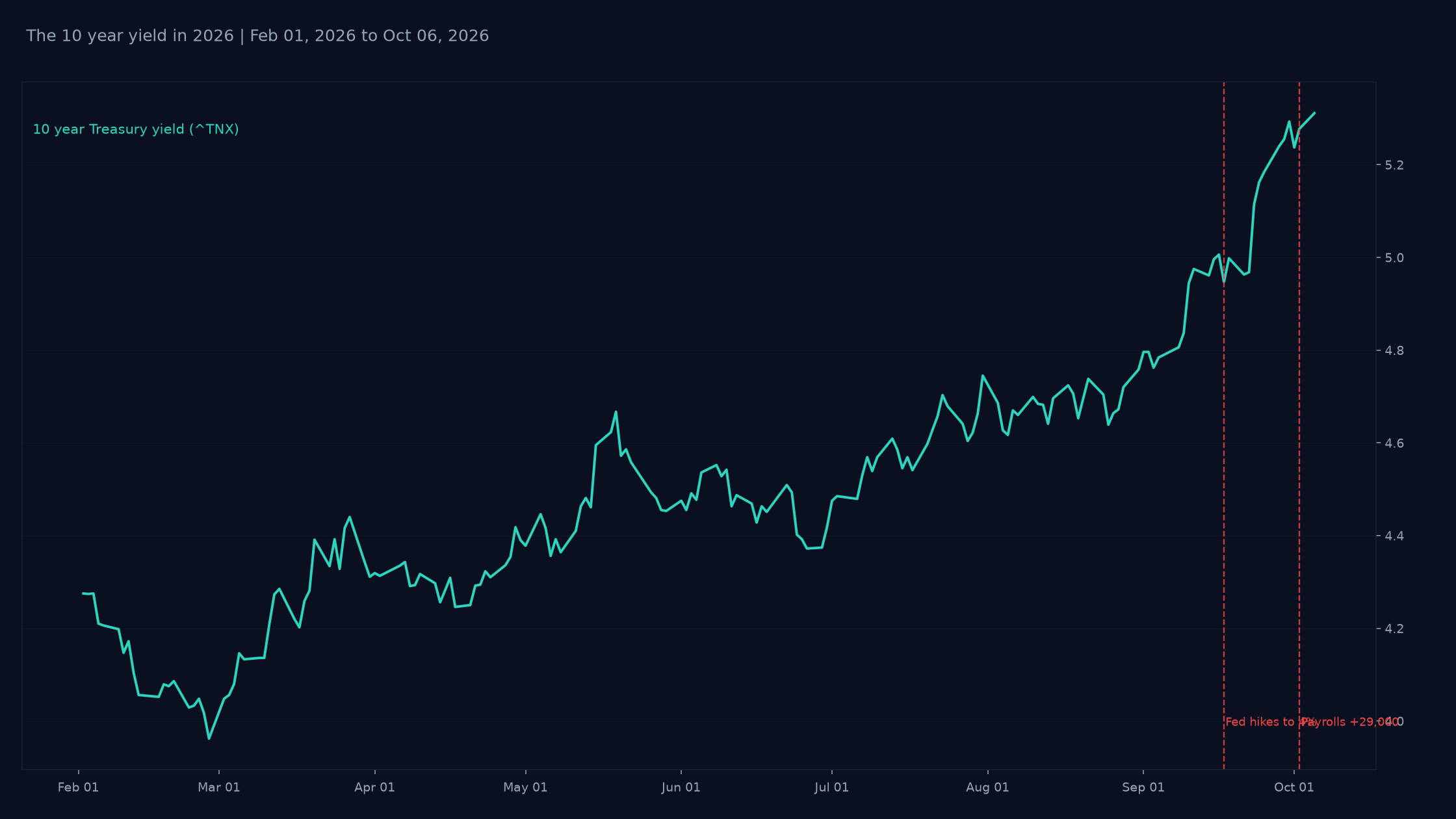
Yields did what that combination implies. The 10 year went from 3.97% on February 27 to 5.28% on October 2 per FRED, and the CBOE 10 year yield closed at 5.31% on October 5, the high of that week. The 2 year was 4.83% on October 2 and the 10 year minus 2 year spread was 0.47% on October 5, so the long end is carrying the move.
Why It Matters for Your Portfolio
If you own long duration anything, this is the setup that hurts. A payroll miss like the one on October 2 would normally rally bonds hard, and it barely did, because somebody still has to absorb $40 trillion of paper at a rising average coupon. The same math caps what you'll pay for long duration equities and keeps cash and short Treasuries paying well over 4% to sit and wait. I'm not calling a crash here, I'm saying the discount rate isn't going back to where it was in February.
What I'm Watching
3 things, with dates. The September CPI report lands October 14, and the FOMC meets October 27 to 28 and again December 8 to 9, so October is the meeting where a hike would catch people flat. CME FedWatch had October at roughly 17% and December above 75% as of October 2, which tells me the risk here is a surprise rather than the base case. On levels I want to see whether the 10 year holds above 5.25% on a weekly close; if it does, the 5.31% print from October 5 is a floor and not a spike, and I stop treating weak jobs data as a reason for yields to fall.
Related Reading: The Market Is Not Buying the Fed Pivot Yet. Here's Why and Japan Pays 4% at Home Now. US Yields Won't Fall in 2026
Howard is a full-time trader based in New Jersey with 13 years of experience across Forex, crypto, equities, and futures. He started Position Note to document his trades and analysis in public. All positions are disclosed. Nothing here is personalized investment advice.