
**Disclosure:** I don't hold a position in NCLH or any security mentioned in this article at the time of publication. This isn't personalized investment advice.
Klarman opened a new position in Norwegian Cruise Line in Q1 2026. So did Elliott's Paul Singer — $246M worth.
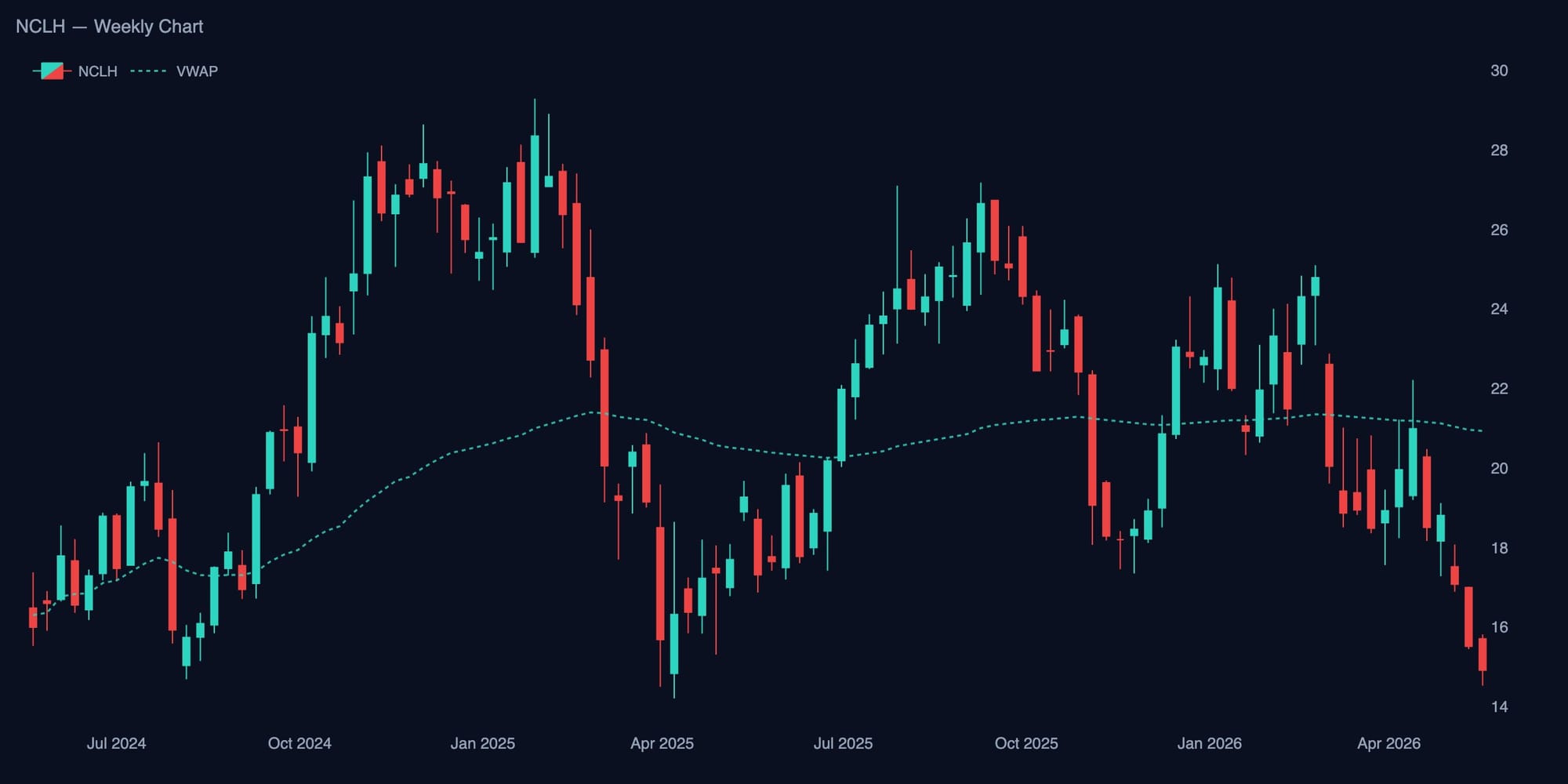
That's a Tier-1 value investor and a Tier-2 activist entering the same beaten-down name in the same quarter, independently. Since those Q1 filings, NCLH has kept falling and is now sitting near 52-week lows, down 45% from its high of $27.18.
That's the signal. Not that one fund bought a cheap cruise stock, but that two very different investors saw the same dislocation at the same time.
Here's what the full positioning looks like and what I think it means.
Tier 1 — Long-Duration
Seth Klarman's Baupost Group opened a new 3,630,000-share position in NCLH.
Klarman doesn't chase momentum. He builds positions in companies the market has given up on when he thinks the price is wrong relative to intrinsic value.
A new entry from Baupost during Q1 matters more now because the stock has since fallen to 52-week lows. It suggests Klarman was already willing to underwrite the business before the latest leg down.
That matters because Baupost isn't a fast-money shop. Klarman is patient, concentrated, and comfortable sitting through pain if he thinks the downside is already priced in.
This is exactly the kind of setup that shows up in his portfolio when the market is focused on the next few quarters and he's focused on normalized earnings power.
Tier 2 — Opportunistic
Paul Singer's Elliott Investment Management opened a new 13,186,000-share position worth approximately $246M.
Elliott is an activist. When they open a position this size in a company with a new CEO running a self-described turnaround, they're not just buying the stock — they're buying influence.
I'm watching for Elliott to push on board composition, capital allocation, debt reduction, or strategic direction over the coming quarters. That's the difference between this and a passive value bet.
Klarman can sit and wait. Elliott can make noise.
That combination is what makes NCLH more interesting than a normal 13F buy. You have one manager underwriting value and another manager with a history of forcing change when the value isn't being recognized.
Tier 3 — Dynamic
Bridgewater also opened a small new position.
I'm flagging it for context, but excluding it from the consensus count because Bridgewater is systematic rather than discretionary. It doesn't carry the same signal quality as Baupost or Elliott.
The counted signal is Klarman plus Elliott: one Tier-1 long-duration manager and one Tier-2 activist entering the same name in the same quarter.
That's enough to make the stock article-worthy. It's not enough by itself to make it a buy.
What the Positioning Actually Tells You
These two managers don't typically end up in the same name.
Klarman is patient, concentrated, and fundamental. Elliott is activist, event-driven, and aggressive.
When they converge on the same stock in the same quarter, it usually means the price dislocation was already obvious enough for different analytical frameworks to reach the same conclusion. The fact that the stock has since fallen further is what makes the current setup worth watching.
The setup here is straightforward.
NCLH beat Q1 earnings — adjusted EPS of $0.23 versus $0.14 expected — but cut full-year guidance from $2.38 to $1.45–$1.79. The company cited Middle East conflict driving fuel costs higher and softening European bookings.
The stock dropped 29% on the news.
The market heard “guidance cut” and sold. Klarman and Elliott appear to be underwriting a different version of the story: temporary headwinds on a business that still has room to repair itself.
That doesn't mean the market is wrong. The bear case is real.
NCLH still has $15.2B in total debt, net leverage at 5.3x, and yield expected to decline 3–5% for the full year. This isn't a clean compounder with a pristine balance sheet.
It's a turnaround with leverage, execution risk, and macro sensitivity. If fuel costs keep rising or European demand weakens further, the equity can stay under pressure.
But that's also why Klarman and Elliott showing up matters.
This isn't a stock investors buy because everything looks perfect. It's a stock investors buy when the market may be overpricing the damage and underpricing the recovery path.
The Bull Case
The bull case rests on three things.
First, NCLH has no significant debt maturities until 2030. That gives management time to execute instead of being forced into a near-term refinancing problem.
Second, free cash flow is expected to turn substantially positive by 2028. If that happens, the debt narrative starts to shift from “balance sheet problem” to “deleveraging story.”
Third, the new CEO is calling this a turnaround from day one. That matters because the market already knows the business is messy.
The question isn't whether NCLH has problems. It does.
The question is whether the additional decline since Q1 has now priced in those problems, and whether the company has enough time and operating leverage to fix them.
That's the bet Klarman and Elliott appear to be making.
The Bear Case
The bear case is just as important.
A cruise operator with high debt doesn't have much room for error. Fuel costs, geopolitics, consumer demand, and pricing all matter at the same time.
If European bookings stay soft, the turnaround gets delayed. If fuel costs spike again, margin improvement gets harder.
If management misses the cost-savings target, the market probably won't give them the benefit of the doubt.
That's why I'm not treating this as a clean value signal. I'm treating it as a watchlist signal.
The 13F tells me serious investors are interested. The chart still has to prove the selling is done.
What I'm Watching
Q2 earnings in late July are the first real read on whether the new CEO's cost-cutting program is working.
Management guided $125M in annual SG&A savings. I want to see whether that number still looks credible after another quarter of fuel pressure and demand uncertainty.
I'm also watching Q3 bookings.
If European demand starts to recover, the thesis accelerates. If the Middle East situation deteriorates further and fuel costs spike again, the debt load becomes a much bigger problem.
The cleanest version of the bull case is simple: cost cuts hold, bookings stabilize, free cash flow improves, and the market stops treating NCLH like the turnaround is already broken.
That's not proven yet. It's just the setup.
Related reading: [The Smart Money Just Moved Into Alphabet — And It's Not Just Buffett]
Howard is a full-time trader based in New Jersey with 13 years of experience across Forex, crypto, equities, and futures. He started Position Note to document his trades and analysis in public. All positions are disclosed. Nothing here is personalized investment advice.